

Pauline Hanson has been one of the most recognisable and controversial figures in Australian politics for three decades. Her political career has been characterised by populist campaigning, strong positions on immigration and national identity, criticism of established political institutions and repeated clashes with opponents over multiculturalism and other social issues. While her views have generated substantial criticism throughout her career, Hanson has also maintained a durable constituency of voters who believe mainstream political parties have failed to represent their concerns.
Born in Brisbane in 1954, Hanson entered politics after a career outside the traditional professional political establishment. Before serving in federal parliament, she was a small-business owner for many years and served as a councillor on Ipswich City Council from 1994 to 1995. This background later became an important part of her political image. Rather than presenting herself as a conventional career politician, Hanson frequently positioned herself as someone speaking for ordinary Australians, small-business owners and voters who felt disconnected from political institutions.
Her national political breakthrough came in 1996, when she was elected to the House of Representatives for the Queensland seat of Oxley. Her arrival in federal parliament immediately attracted significant public attention. Her positions on immigration, multiculturalism, Indigenous policy and Australian identity generated intense debate and made her a highly polarising national figure. Supporters saw her as willing to raise subjects they believed mainstream politicians avoided, while critics argued that some of her rhetoric contributed to prejudice and social division.
In 1997, Hanson became associated with the establishment of One Nation, creating a political vehicle for a broader populist movement. The party attempted to challenge Australia’s established political order by appealing particularly to voters dissatisfied with both major parties. Economic insecurity, regional concerns, immigration, national sovereignty and distrust of political institutions became recurring elements of its political message. Although One Nation experienced significant internal and electoral difficulties in subsequent years, Hanson remained closely identified with the movement.
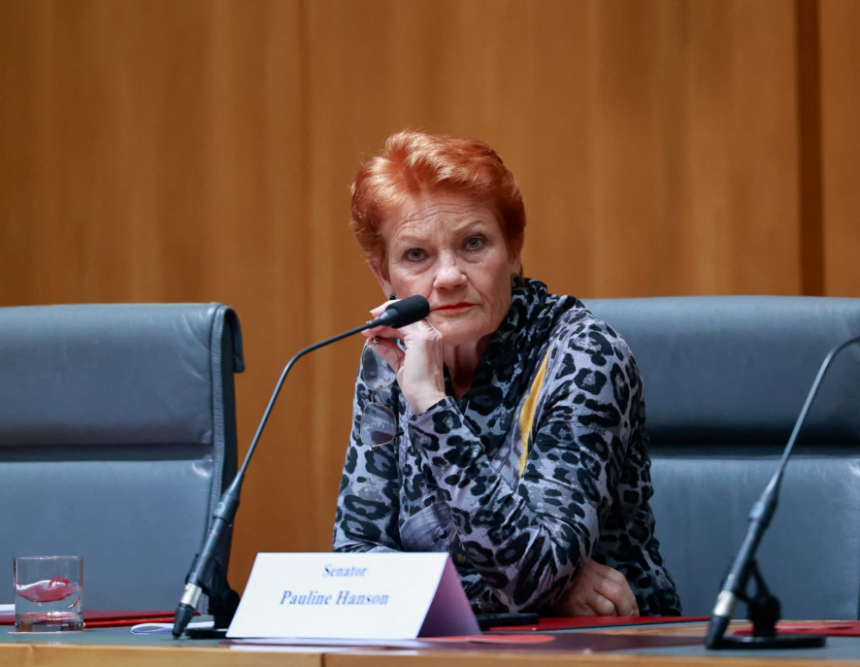
Her first period in the House of Representatives ended after the 1998 federal election, but that did not mark the end of her political career. After years outside federal parliament and several attempts to return to elected office, Hanson successfully entered the Australian Senate as a senator for Queensland in 2016. She was re-elected in 2022, demonstrating that her political appeal had survived long after her initial emergence in the 1990s. Australia’s parliamentary records list her as a Queensland senator and, as of 2026, Leader of One Nation.
Hanson’s political longevity is particularly notable because Australian politics changed considerably between her first election in 1996 and her later Senate career. The rise of social media, changing patterns of migration, debates about climate and energy policy, the cost of housing and living, and declining trust in institutions created a political environment in which anti-establishment parties could continue finding an audience. Hanson adapted many of her longstanding themes to these newer debates while maintaining the direct and confrontational communication style for which she had become known.
Immigration remains one of the subjects most closely associated with her politics. Hanson has consistently advocated more restrictive approaches to migration and has criticised what she regards as excessive population growth and failures of multicultural policy. These positions have made her an influential voice within Australia’s immigration debate but have also attracted sustained criticism from political opponents, community organisations and others who argue that her rhetoric can stigmatise minority communities.
She has also strongly challenged policies associated with achieving net-zero emissions and has connected energy policy with household expenses and economic competitiveness. More broadly, One Nation under Hanson has presented itself as an alternative to both Labor and the traditional centre-right parties, particularly on questions involving national sovereignty, immigration, energy, government spending and freedom of expression. In a February 2026 Senate speech, Hanson explicitly attacked both the political establishment and the Albanese government while arguing that One Nation should remain independent rather than becoming part of the conventional two-party structure.
An important feature of Hanson’s career is the extent to which public controversy has become intertwined with her political identity. Statements that generate condemnation from opponents often simultaneously reinforce her appeal among supporters who believe political debate has become too restricted or disconnected from public concerns. This dynamic has allowed Hanson to remain visible in national politics even during periods when One Nation held relatively limited parliamentary representation.
At the same time, understanding Hanson requires distinguishing political influence from universal acceptance. She remains an exceptionally divisive figure. To supporters, she represents resistance to political elites and a willingness to challenge established assumptions. To critics, her politics represent a form of populism that can intensify social divisions and oversimplify complex economic and cultural questions. Both reactions have accompanied her for much of her public career.
Pauline Hanson’s importance in Australian political history therefore extends beyond the number of seats her party has won. Her career illustrates the persistence of populist and anti-establishment politics in Australia and the capacity of a politician to build a durable public identity around issues that provoke strong emotional responses. From local government in Queensland to the House of Representatives and eventually the Senate, Hanson has repeatedly returned to national prominence despite political setbacks that might have ended another politician’s career.
Three decades after she first entered federal parliament, Pauline Hanson remains an active participant in Australian politics. Her continuing presence demonstrates both her ability to retain a committed political audience and the persistence of the debates that have surrounded her since the 1990s. Whether viewed as a representative of neglected voters or as one of Australia’s most controversial political figures, her impact on the country’s political conversation is difficult to ignore.