

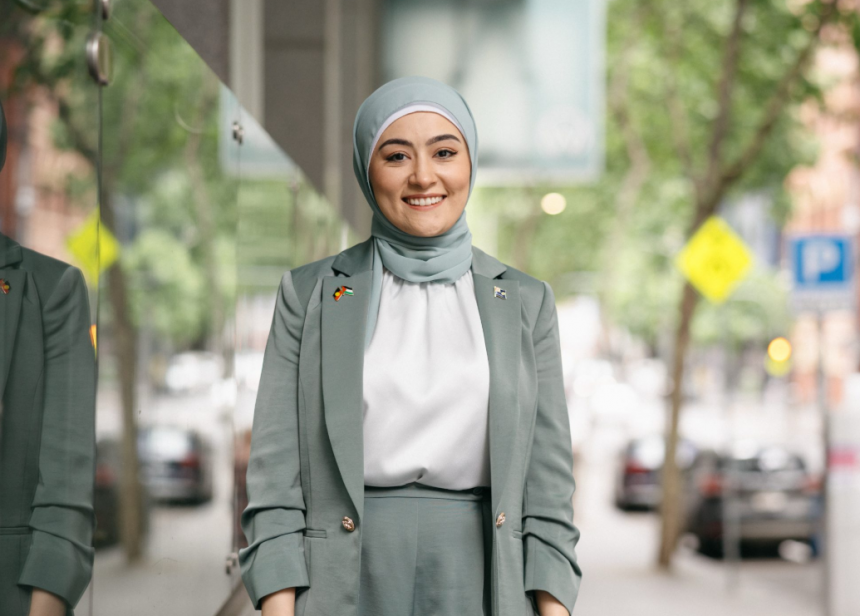
Fatima Payman represents a very different generation of Australian political leadership. Born in Kabul, Afghanistan, in 1995, she migrated to Australia with her family as a child and eventually entered federal politics at a remarkably young age. Her personal background, rapid political rise and eventual break with the Australian Labor Party have made her one of the most closely watched younger politicians in the Australian Senate.
Payman’s family migrated to Perth in 2003. Her experiences as a migrant and the experiences of her family became important influences on her later political interests. She studied at the University of Western Australia, completing qualifications including a Bachelor of Arts and a Graduate Diploma in Pharmaceutical Science. Before entering federal parliament, she worked as a pharmacy assistant, an electorate officer and an organiser for the United Workers Union.
Her involvement with organised labour helped provide a pathway into politics. Payman became active within the Australian Labor Party and held positions in Western Australian Young Labor, including serving as its president in 2021. Her work within the labour movement placed issues such as workplace rights, economic opportunity and representation at the centre of her early political career.
At the 2022 federal election, Payman was elected to represent Western Australia in the Australian Senate. Her election attracted national attention partly because of her age and background. She became the first hijab-wearing Muslim woman to serve in Australia’s federal parliament, giving her election symbolic importance in discussions about Australia’s increasingly diverse population and political representation.
Payman’s first years in parliament included work across several committees dealing with areas such as foreign affairs, defence, trade, migration, education, employment, communications and artificial intelligence. She also served as chair of the Senate Standing Committee on Publications and deputy chair of a select committee examining dental services in Australia.
Her political trajectory changed dramatically in 2024 as the war in Gaza became an increasingly divisive issue within Australian politics. Payman publicly advocated recognition of a Palestinian state and became increasingly critical of her own government’s position. The disagreement ultimately created a significant conflict between Payman and the Labor Party.
In June 2024, she crossed the Senate floor to support a motion concerning recognition of Palestinian statehood, voting against the position taken by her own party. Crossing the floor is particularly significant within Australian Labor because party discipline traditionally requires parliamentarians to vote according to the agreed caucus position. The episode therefore transformed what had been a policy disagreement into a fundamental question about Payman’s continued membership of Labor.
On 4 July 2024, Payman resigned from the Labor Party and began sitting as an independent senator. Several months later, in October 2024, she launched a new political party called Australia’s Voice. Parliamentary records currently identify her as a senator for Western Australia representing Australia’s Voice and serving as the party’s whip.
The decision was a striking development for a politician who had entered federal parliament only two years earlier. Instead of continuing her career within one of Australia’s two dominant political parties, Payman attempted to establish an independent political identity. Australia’s Voice sought to appeal to voters who felt insufficiently represented by the established parties, although building a successful national political organisation proved difficult.
Her political story also reflects broader changes taking place within Australian politics. Younger voters, migrant communities and voters dissatisfied with traditional party structures are increasingly important parts of the electorate. At the same time, independents and minor parties have demonstrated that political influence is no longer confined entirely to Labor and the Liberal-National Coalition.
Payman’s background gives her an unusual position within this changing environment. She combines experience inside the Labor movement with the perspective of someone who subsequently left that system. Her decision to break with Labor demonstrated a willingness to accept significant political consequences over an issue on which she strongly disagreed with her party.
It remains too early to know what Payman’s long-term political career will look like. She entered parliament at an unusually young age, meaning she potentially has decades of political life ahead of her. Building a durable minor party is notoriously difficult in Australia, and her future influence will depend on whether she can broaden her political appeal beyond the circumstances that originally brought her national attention.
Nevertheless, Fatima Payman has already secured a distinctive place in contemporary Australian politics. Her journey from Kabul to Perth and eventually the Australian Senate represents one aspect of the country’s changing social landscape, while her departure from Labor illustrates the tensions that can arise between party discipline and individual political conviction. Whether her future lies in building a lasting political movement or pursuing a different path, her first years in parliament have already been unusually consequential.