

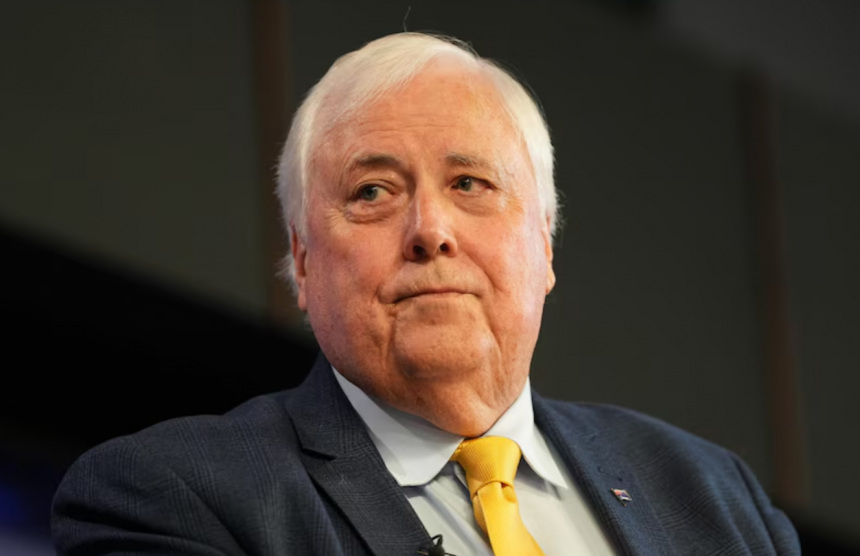
Clive Palmer is one of Australia’s most recognisable businessmen and political figures, known for a career that has moved repeatedly between mining, major commercial ventures and federal politics. Over several decades, he has built substantial business interests in Australia’s resources sector while also becoming famous for ambitious projects, enormous political advertising campaigns and a highly unconventional approach to public life. His combination of wealth, political activism and media visibility has made him a distinctive and often controversial figure in modern Australia. In 2026, Forbes estimated his fortune at around US$4 billion, reflecting the scale of his resources interests.
Born in Melbourne in 1954, Palmer spent much of his formative life in Queensland. His eventual business career became closely connected to Australia’s enormous mineral resources. One of the most important companies associated with him is Mineralogy, which Palmer established in 1984. The company developed interests in iron ore and other resources, helping form the foundation of the fortune that would later make Palmer one of Australia’s wealthiest individuals. His portfolio has also included coal, nickel, hydrocarbons, property and tourism-related investments.
Palmer’s business activities have frequently attracted significant public attention. Unlike many wealthy Australian entrepreneurs who remain relatively distant from everyday political debate, Palmer developed a highly public persona. His business announcements have often been accompanied by ambitious plans and large-scale publicity. One of the most internationally recognised examples has been his long-running proposal to build Titanic II, a modern ship inspired by the original RMS Titanic. The project generated enormous international media coverage and became representative of Palmer’s preference for ventures capable of capturing public imagination.
His political involvement, however, transformed him from a prominent businessman into a national political personality. Palmer had previously been associated with conservative politics, but in 2013 he established the Palmer United Party and entered federal politics directly. At the 2013 federal election, he won the Queensland seat of Fairfax in the House of Representatives. His victory was notable because it demonstrated that a newly established political organisation backed by a wealthy founder could successfully challenge Australia’s established parties.
Palmer served as the federal member for Fairfax between 2013 and 2016. During this period, Palmer United Party representatives also held influential positions in the Senate, giving the party considerable importance when the government needed support for legislation. The party’s rapid emergence demonstrated the potential influence of minor parties within Australia’s parliamentary system, particularly when neither major political bloc had straightforward control of the Senate.
The original Palmer United Party eventually declined, but Palmer did not disappear from Australian politics. He later revived the United Australia Party name and invested heavily in national election campaigns. His political strategy became particularly notable for its enormous advertising expenditure. Palmer used television, newspapers, billboards, digital advertising and mass communications to give his political organisations a level of national visibility unusual for minor Australian parties.
This strategy was especially visible during subsequent federal elections. Although large advertising campaigns did not translate into a comparable number of parliamentary seats, they ensured that Palmer and the parties associated with him remained prominent in national political discussion. During the 2025 federal election, Palmer reportedly spent tens of millions of dollars on political campaigning, including substantial spending on digital platforms.
His political messaging has often focused on distrust of established political parties, government regulation, national sovereignty, economic management and individual freedoms. Like many populist political movements internationally, Palmer’s campaigns have attempted to appeal to voters who believe the conventional political establishment does not adequately represent them. His substantial personal resources have allowed him to communicate these messages on a scale that would normally be impossible for a small political organisation.
Palmer has also demonstrated an unusual ability to repeatedly reinvent his political organisations. Parties associated with him have appeared under different names and structures over the years, while his personal political brand has remained remarkably consistent. In March 2026, Palmer again announced his intention to return to electoral politics, indicating plans to contest the Queensland seat of Fadden at a future federal election.
Outside politics, Palmer continues to pursue projects that reflect his interest in collecting and large-scale ventures. In August 2026, a Brisbane exhibition associated with Palmer showcased more than 200 vehicles from his collection, which reportedly contains over 1,000 cars. The exhibition included vehicles from historically significant and luxury manufacturers, and Palmer has also been developing plans for a major automotive museum in Queensland.
Clive Palmer’s public career is difficult to separate into conventional categories. He is simultaneously a mining entrepreneur, billionaire investor, political campaigner and public personality. His supporters often view his willingness to challenge established political institutions as evidence of independence, while critics have questioned the influence that enormous personal wealth can have on political communication and elections.
Whatever one’s assessment of his politics or business activities, Palmer has demonstrated a remarkable ability to remain part of Australia’s national conversation. Few Australian businesspeople have crossed between commerce and politics as visibly or repeatedly. From mining and parliamentary politics to enormous election campaigns and ambitious personal projects, Clive Palmer has created a public profile unlike almost any other contemporary Australian entrepreneur.